
Fischers in Peru

Meetings in Salinas Huito

24 Apr 2023

Salinas Huito is a small town on the edge of a high-altitude salt lake, named Laguna de Salinas, or the 'lake of salt'.  We have similar kinds of lakes in Australia, which like Laguna de Salinas are dry for most of the year, but when the rains arrive life just teems.  Unlike salt lakes in Australia, though, the altitude of Laguna de Salinas is about 4,300 metres, which means oxygen levels are getting down to about 1/2 those of sea level -- so that takes some getting used to.  On top of that, the nights are often below zero, even in summer.
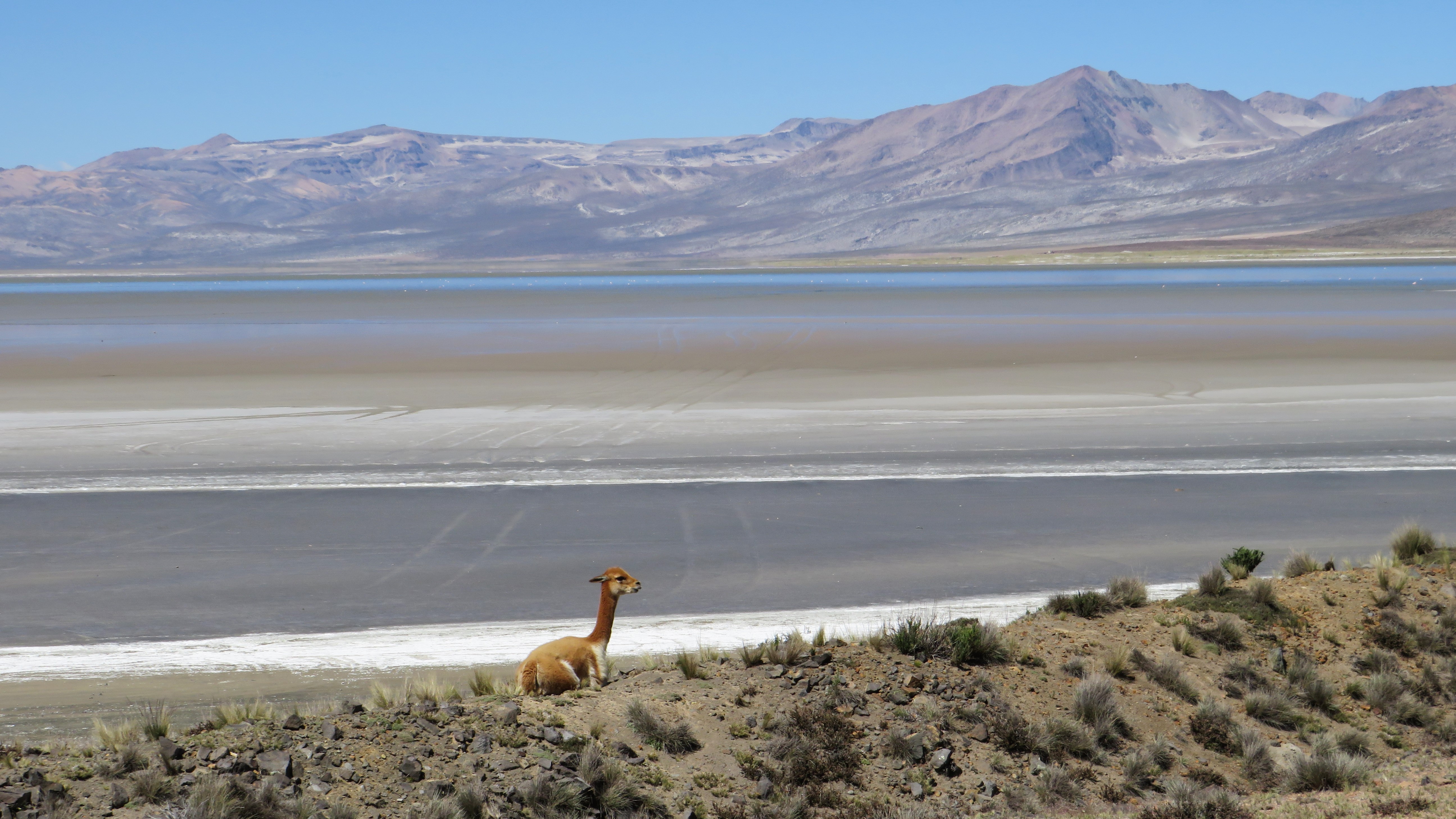
Above:  Wary vicuña resting on the lake shore, Laguna de Salinas.

Last weekend (22-23 April, 2023) I drove with Peruvian pastor mate Edgar to Salinas Huito for an ETE (Educación Teológica por Extensión) gathering.  Students from Salinas Huito and Salinas Moche (the town on the other side of the lake), as well as a few from further afield, got together to organise their studies for the next semester.

On the Sunday morning I was invited to preach (typically I know nothing of these plans until I turn up; it's all organised in a 'seat of the pants' kind of style).  In many ways I would rather hear our Quechua brothers teach from the Scriptures, but (i) they insist, (ii) I need to learn to relate to them, and (iii) I should model what we're trying to teach and get across.  So on these occasions I cave in and inflict my basic (but improving) Spanish upon them.  It's not like Spanish is their preferred language, anyway (they much prefer to chat with each other in Quechua), but that's our only common language, so Spanish it is.

I spoke from Revelation 7; "That sounds a bit ambitious," you say.  But (i) it's a great passage about God's age-old purpose of having a chosen people from every tongue, nation, tribe, people and language (v.9) who declare the glory of the One who has redeemed them, and (ii) it helps our Quechua brothers and sisters see how passages which are normally clouded with hocus-pocus interpretations are, in fact, clear declarations of what it means to live as God's people in a world which stands against them.

"Not many in that church service," I hear you think.  You're right; that was because the local authorities had called a community meeting for Sunday morning, and they issue fines to anyone who doesn't attend!  While I can't comment for sure on this instance, it has to be said that this is how Christians in these remote communities are often treated; things are often quite deliberately stacked against them.

We've just got through a very good wet season (normally Dec--Mar.) here in Peru, and so there has been plenty of water finding its way into Laguna de Salinas.  This, in turn, means there is plenty of wildlife on the water: flamingos, geese, and ducks in abundance.

Above:  The green pasture of Laguna de Salinas, with the active volcano Ubinas in the distance.  For years it's been throwing up a column of ash and shaking the land with its rumblings, but for the moment it's gone quiet.  Who knows how long that will last?

Below:  A pair of geese with this year's offspring, heading off to the water before the bloke with the camera got any closer.

With summer and autumn being the wet season here, it's also the warmer weather.  Still below zero at night, and plenty of frost on the cars in the morning.  When I muttered something about the cold to one of our Quechua sisters, she said, "Hah!  You should have been here last July!"  Um, no thanks; it was cold enough sleeping fully clothed, with beanie and gloves, and two thick blankets over my sleeping bag.

Below:  A peak to the north of the lake, with permanent ice stuck to its sides.

Edgar himself was so glad to be able to come along on the trip.  Pastoring a church in Arequipa, but originally from a rural community outside Cusco, he really enjoyed the opportunity to mix again with Quechua believers.

Below:  ETE director René (left), Daniel (Presbyterian missionary from Korea, center), and Edgar (right), organising something or other.

Above:  Evening light across the lake.  For me, it was a strange thing to consider that at the lakeside were were above the clouds, but still had peaks higher than us.  In the distance are the peaks known as Picchu Picchu, rising to about 5,600m, with Arequipa over the other side, about 3,300m below.  Everything was cold, beautiful, and silent.

Sunday after lunch we wound our way back to Arequipa -- a 3-hour trip which takes you down from 4,300m to 2,300m.  It really is a 'vertical' landscape.

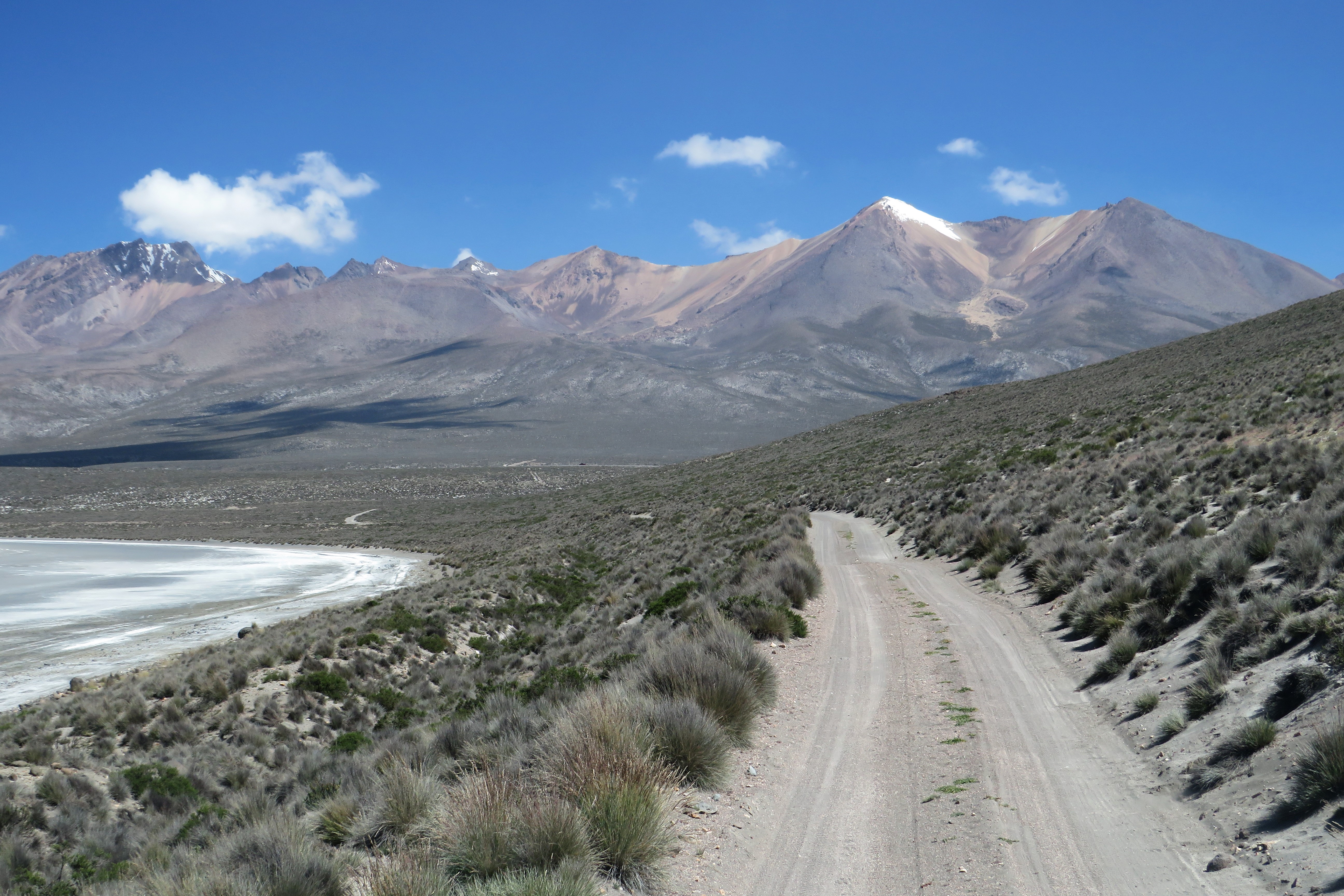
We had the usual load of folks to drop off at their farms on the way home, which took us on some less-used tracks around the lake (below).  Edgar got home about as tired as I did, but already asking when the next trip might be, and could he come along?  Well, of course he can!
Visit to Cota Cota

03 Mar 2023

Have you ever heard of Cota Cota?  That's OK, most Peruvians haven't either.  It's out the back of Tisco, which is out the back of Chivay, which is out the back of Arequipa.  A population of only a few hundred.  Cold, remote, and at about 4400 metres it's double the altitude of Arequipa, and so unless you're a local you'll find it easy to run out of puff.

On the upside, it takes about 5 hours' drive through the usual breathtaking Andean scenery to get there.  And it was where IBSA (one of Arequipa's three theological colleges) ran a week of classes and presented certificates to about 18 students from the area.  So it was that last Tuesday and Wednesday Ben (SIM colleague), Jimmy (Peruvian pastor mate here in Arequipa) and myself lobbed into town.

Below: main plaza in Cota Cota.

While we don't have any direct role in this program (yet?), it's a great chance to meet the students, have conversations with them, get a feel for what the needs and opportunities might be, and grow in our appreciation of chuños (potatos which are freeze-dried in the soil during winter) and alpaca soup!

Below: Mike and Ben chewing on some roast lamb while discussing the Trinity (no, really) with some of the faculty and students.  Caption competition for this photo is now open.

The Wednesday night was the graduation service.  For me, a 1.5 hour-long service is fine; but to be honest, four hours is another matter.  There were lots of speeches, and long lists of people to thank.  At first I found myself muttering under my breath that it was going on way too long.  But in a culture which puts a far greater premium on honour than we Australians do, thanking everyone is very important.  Add to that the fact that this was the once-in-a-year chance for the students to get together, receive their certificates, and celebrate their hard work... well, seen from that angle maybe four hours wasn't that unreasonable.  Just about everyone had something to say and plenty of people to thank.  It's the way they do things around here, and if the outsider can find 5 minutes to stop muttering and belt up and listen, he or she just might learn something ;-)

Below: the 18th speech (estimate only) for the evening, this time from the local alcalde (town mayor).

Above: the students with their hard-earned certificates.

At about midnight we finally got to hit the hay.  Ben and Jimmy were fine, but I copped a bout of soroche (altitude sickness) and ended up getting very little sleep.  This is the way it is with soroche; some trips you're fine, other trips you're not.  There are all sorts of medications available, but I haven't had much joy with any of them.  I find that my own little concoction of aspirin and caffeine pills deals with most of it, but of course the caffeine isn't much good for sleeping.  So essentially I'm faced with a choice: either a sleepless night with a thumping headache, or a sleepless night courtesy of the caffeine.  I think I prefer the latter!

Below: being summer here it's the wet season, so the lakes are full and the pastures green.

Above: well-fed beast on the Cota Cota football field.

Thursday morning breakfast was fried trout (there are plenty farmed in the streams and rivers around the southern Andes), and then we fired up the Hilux and headed back home.  I plan to be back in Cota Cota next May, this time as part of ETE (theological extension program).  It will be good to catch up with everyone and see how they're getting along with their studies, their Christian service, and life in general.

Trip into the north of Peru

29 Jan 2023

January arrived, the month of our team conference, but after that came the opportunity to take some time off.  For us Fischers, that can only mean one thing: a road trip!

We packed up the Hilux, and in convoy with colleagues Ben and Daniela and their 4 lads, our first day's journey got us to Nazca, where we lodged for a couple of days.  Nazca, of course, is most famous for its geoglyphs -- enormous designs drawn into the desert surface centuries ago by the now vanished 'Nazca culture'.  We had seen some of these last year while on the way to pick up our daughter Jocelyn from Lima (there is a high viewing tower outside Nazca), so instead Kerry, Megan and I trooped about 20 kms out of town to see a partially-excavated ancient cemetery.

The dead were buried wrapped up in a bundle, and seated upright.  As you can see, the person in the photo above had an impressive set of dreadlocks, all preserved in the arid desert climate.

From Nazca we drove up to the 'Kawai' campsite, about 1 hour south of Lima, where we had our annual SIM conference/ retreat for about 5 days.  This gave us the chance to catch up with the rest of the SIM team from other parts of Peru, and this year's speaker encouraged us from Psalm 119 with some great insights into the chapter.

Ben and tribe headed back south to Arequipa, while we Fischers pointed the Hilux north towards Cajamarca, via the coastal city of Trujillo.  North of Lima there is the 'Fortress of Paramonga', another pre-Inca site.  We climbed to the top and took in the lush countryside of the surrounding river plain.

We stayed in Trujillo for a couple of days, and (of course) visited yet another pre-Inca site.  There are many old mud brick pyramids dotted along the coast and in the river valleys.  This one is called 'El Brujo' (translated, 'the wizard').  Because most of these pyramids went through stages of development over the centuries of their use, excavations have been able to reveal the superbly well-preserved ealier pyramids still inside the weathered outer structure.

Like many of these 'pyramid cultures' of the Americas (e.g. the Aztecs of Mexico), human sacrifice (typically of captured enemy warriors, it seems) was practiced.  In the picture above you can see the main figure holding the head of a decapitated victim.  On a nearby part of the 'El Brujo' site, burial pits containing the bones of hundreds of sacrifical victims have been excavated.

Trujillo is also well-known for its surfing culture -- but using traditional 'boards' made out of bundles of reeds:

After Trujillo it was on to Cajamarca -- a most significant city in the history of Peru.  It was here, in a terrifying and bold move, that the conquistador Francisco Pizarro captured the Inca emperor Atahualpa.  Now being held hostage, and realising that the Spaniards were particularly interested in gold, Atahualpa offered to fill a room with gold to buy his freedom.  This was duly done, but by then the Spaniards were convinced (so they said) that Atahualpa had been plotting against them, and so they then executed him on the charge of treason.

The room in which Atahualpa was held prisoner survives to this day, close to the centre of the city:

Some other photos from around Cajamarca during our stay there:

After Cajamarca we headed south to visit the national park of Huascarán -- the highest mountain in Peru.  We wound our way through stunning mountain scenery and beautiful little villages, driving along tortuous roads with innumberable hairpin bends -- some so tight that a 3-point turn was needed.  After a long day's drive we were only about 1 hour short of Tauca, our stop for the night before reaching Huascarán, when we were confronted with this:

This landslide wasn't going to be cleared overnight, so with only about a week left of our time off, Mike had to pull off a 15-point turn (estimate only) and we pointed the Hilux back the way we had come.  Maybe we'll get to see Huascarán another time ;-)  This turned out to be the first forced change of route for the trip -- but all it did was reveal yet more wonders of this spectacular country:

Old Inca terraces in the morning sun:

Video footage of driving Andean roads:


Then we turned south and started heading back home to Arequipa.  We went to pass through Ica (on the way to Nazca) but the protesters there had barricaded the highway, so we had to take our second forced detour: through the desert of the Paracas national park.  Once again the Hilux (by now nicknamed 'Burrito', or 'little donkey') acquitted itself magnificently, coping with the sandy tracks across the dunes and taking us through the breathtaking desert valleys.  We even saw flamingos in the saltwater lagoons along the ocean's edge!

We managed to slip around to the south of Ica and then it was on to Nazca, our last stop before home.  Because of all the protests and blockades which have been going on for weeks and weeks now, it was impossible to find diesel in Nazca.  So we decided to keep on heading south, in the hope that we'd find a more remote grifo (service station) with some diesel to spare.  On we drove, watching the fuel gauge needle dropping lower and lower, until it was at about 1/8... at which point we were seriously considering just stopping in the next coastal town and camping on the beach.

But then at a town called Tupac Amaru (named after another Inca emperor) we found this grifo receiving a fresh load of fuel:

Well that was a relief!  So, with landslides, blockades and fuel shortages behind us, it was on to Camana, the last coastal town before heading inland to Arequipa.  Just one snag: the blockade in Camana had not been removed, as we'd been led to believe.  So we spent a tense 30 minutes or so waiting with unbelievably long columns of trucks, to see if the police could get things open again.  Thankfully they did!  The police in Peru generally have a bad public reputation, but at times like this everyone is grateful for how skilfully they handle these worked-up protesters.

So we got back home with a filthy Hilux and a much greater understanding and appreciation of Peru: its history, its geography, its people, its needs.  And Megan was thrilled to see the cats Princesa and Ozzy again.

Now we turn our minds again to helping meet the training needs of pastors here.

On cuppas at altitude

18 Dec 2022

Well, I got to wondering a bit about altitude, living as we do at 2,300 metres here in Arequipa (which is pretty-much the height of Mt. Kosciuszko).  We all know that water boils at 100 deg. C at sea level -- but what about at 2,300 metres?  Or at 4,200 metres (Tisco, here's looking at you)?

[In the old days, boys and girls, for question like this the avid student would reach for the Encyclopaedia Britannica, which most households had courtesy of those door-to-door salesmen.  But like a lot of things, the internet kind of wrecked that business model, so now you just use your smartphone instead.]

So here's the deal: the boiling point of water here in Arequipa works out at about 93 deg. C, which probably explains why our electric kettle is so reluctant to turn off automatically.  And it also helps explain why we don't seem to burn our lips so often with a fresh cup of tea.  Want to find out the boiling point of water at your altitude?  Look it up on this graph here.

What about oxygen availability?  We've all seen the doccos: if you want to make it to the top of Everest (8849 metres), then oxygen cylinders are an excellent idea.  So here in Arequipa?  Another handy graph settles the question: at sea level there is 20.9% oxygen available.  Here in Arequipa that's down to 15%.  So I guess that means that with each lungful we're getting 25% less oxygen here than we would in Perth.  No wonder we found ourselves gasping (more than usual) while climbing stairways!

Ah, the mighty smartphone.  Makes even me feel smart.  Although I do feel a bit nostalgic for the old Encyclopaedia Britannica...

Mercado San Camillo

16 Dec 2022

The oldest market here in Arequipa is 'Mercado San Camillo', part of the old centre of town and always plenty of stuff happening.  It's here that you can find stalls with just a few of the hundreds of varieties of potato:

That might look exotic enough, until you find the guy who sells the big fat grubs:

The sign board assures the shopper that these things are just the ticket for fixing elbow, knee, and back pain.  Also good for arthritis and migraines, it says.

We haven't seen these for sale at the market before, so they must be a seasonal thing.  The vendor had plenty of interested customers.

All this is strange enough for the average Australian.  But things get even stranger when you come across the stall that sells -- among other things -- dried llama foetuses.  We are told that these are for burying beneath the threshold of your new house, to make sure that it and the occupants are blessed.  (Maybe it's not that strange, though; European cultures have been putting gold coins under thresholds for centuries.  And I can remember seeing Aussies throwing in coins as the concrete slab was being poured for their house, too.)

There were even a couple of much larger baby llamas, dried out and supplied with glass eyes:

I wonder what Peruvians would find strange and weird if they were to visit the Victoria Markets in Melbourne, or Canningvale Markets in Perth?

42 -- which they say is the answer to life, etc.

24 Oct 2022

Friday October 24th, 1980.  I remember it like it was yesterday.  It's the day I became a Christian.  42 years ago, to the day.  And if you like, you can read some of the story here, at my motorcycles etc. website.

A year or two later, I got to wondering.  Because you cannot be a Christian without thinking, "you are not your own, but you were bought with a price".  And that since your life is no longer your own, but to be lived in honour of the One who laid down his life for you... well, what now?

I happened to be attending a very missionary-minded church at the time.  And part of the vibe of the place was that there was world out there with billions of people who had not even heard of Jesus, or that "God so loved the world that he gave his one and only Son".  So I thought, Maybe I could gear my life around doing something along the missions side of things?  South America -- its history, exploration, and hispanic culture -- had started to fascinate me.  So the idea of missions somewhere in South America got a hold of my brain.

About 10 years later -- after finishing university, theological college, and getting hitched to the lovely Kerry -- we had a serious crack at going to Ecuador, but there were difficulties with the organisation and things just didn't work out.  And then our 2nd kiddo Megan was born, and so we needed to put off any idea of overseas work as life with Meegz took shape.  Now, the massive news about Jesus being the most important thing, we channelled our energies into local church ministry in Western Australia.  After all, the main thing is not where one plugs the gospel, but that one plugs the gospel according to the abilities, circumstances, opportunities and resources that God plops in your lap.

So, in God's time, here we are in Peru.  And we just want to say a big fat THANK YOU to everyone who takes an interest in what we're up to, and supports our work however they can.  It's a team (church-wide) effort.  Onwards!

Andean Music for the Soul

29 Sep 2022

Last Sunday night we joined in the anniversary service for one of the local churches.  One of our church musicians, Davíd, is a member of a local Christian band -- Inspiración Andina -- that plays a traditional Andean form of music.  So they really helped crank things up!  It was wonderful to see how the Andean rhythms just 'gelled' so quickly with everyone; towards the end of the set many were on their feet shouting and clapping.  Here are a couple of snippets of the proceedings...


¡Temblores y Terremotos!

13 Jul 2022

In good ol' Oz, thankfully, earthquakes are very rare.  Meckering WA ,1968, 6.9 on the Richter scale, and Newcastle NSW, 1989, registering 5.6 ... and those are about all the ones I can think of.  At least, the ones that were pretty destructive.  And it's worth noting that they have gone down in history as "earthquakes", and not mere "tremors".

I mean, I remember a few tremors when I was living in Melbourne as a kid.  The glasses would tinkle on the shelf.  The windows would vibrate a bit.  And that was about it.  If you weren't paying attention, tremors were easy to miss.  And here in Peru there is a similar terminology: tremors are known as "temblores", and earthquakes are known as "terremotos".

Now, in the last 24 hours here in Arequipa, we've had a few, shall we say, seismic events.  The whole building has visibly shaken from side to side (while you're in it).  You'd think a truck had just ploughed into the house.  Car alarms go off and the dogs start going berko.  People empty into the street.

Then you check the seismic data online, and yep the epicentre was only about 50kms away.  At a depth of 10km, and at 5.5 on the Richter scale.  And in Australia this would have done a lot of destruction in any nearby town or city.  It would have gone down in the history books for sure -- as an "earthquake" (image courtesy of earthquaketrack.com):

So how do the locals of Arequipa describe a seismic bit of biffo like this?  Is it a "temblore" or a "terremoto"?  Well guess what, it all depends what you're used to, and how well built your buildings are.  Here in Peru, seismic hiccups and burps are a dime a dozen.  And every building worth its salt (and there are a few that aren't, especially in the poorer districts) is built from reinforced concrete, with walls at least a foot thick.

So after what seems like a good seismic clobbering to us Australians, which would have probably flattened a town in Oz, the locals are all talking about... those "temblores" we just had!

Now it's not that Peruvians are blase about seismic biffo -- far from it.  Preparation for earthquakes is promoted constantly.

And so most people have emergency kits ready to go (water, food, blankets, cash, first aid equipment, torches, etc.).  Everyone remembers well the day the old cathedral towers in the Plaza de Armas came tumbling down.  Many died, and thousands were left homeless.  Government emergency vehicles carry equipment you would never see in Austalia: rigid stretchers, shovels, and the rest.

Below: the moment the cathedral towers came down, Arequipa 2001.  Actually only the one on the left fully collapsed; the one on the right somehow remained balanced in position.  Notice the pigeons going nuts, but people rooted to the spot.  (Photo sourced from Pinterest.)

Anyway, we Fischers have decided we'd better follow SIM Peru's protocols and get serious about our emergency kit... somehow we've overlooked that in all the other rumpus of settling in!

Pages

Subscribe to RSS - Fischers in Peru's blog